Skip to content

Satellite image of U.S. Credit: Wikipedia

Many environmental protections are now in the process of being rolled back in the United States, including those for formaldehyde. This is a huge win for the chemical industry (more profits!), and a loss for us. For our health and for the environment.

Formaldehyde is used in many consumer products, such as personal care products, paints, crafting products, particle board, composite wood (e.g., furniture, cabinets), textiles, plastics, furniture foam. The problem is that it out-gasses and we inhale it, which can lead to health harms, such as effects on the skin and respiratory system and several types of cancers. Formaldehyde  causes more cancer than any other chemical in the air.

The EPA is now proposing raising levels of formaldehyde that are "safe" for us to be exposed to. It wants to double the allowable threshold levels! The EPA sets standards for chemicals that say that any level of exposure below that threshold is considered safe. Therefore, levels of exposure to formaldehyde that are now considered a cancer risk will not be if the changes are approved.

Why these rollbacks? Chemical industry friendly people are now in charge of the EPA (top staffers are from the chemical industry) and the new focus is on economic development, prioritizing business interests, and not protecting human health and the environment. Of course research scientists and research are being thrown out.

Excerpts from The Guardian: Trump’s EPA wants to weaken formaldehyde protections – this is what it could mean

Donald Trump’s Environmental Protection Agency (EPA) is proposing to increase the levels of exposure to highly carcinogenic formaldehyde it considers safe. If successful, people would continue to be exposed to concerning amounts of the toxin in thousands of everyday products used across the economy, experts and advocates say. ...continue reading "Weakening Formaldehyde Regulations Will Harm Us"

Scientists have long known about some factors linked to a higher risk of developing multiple sclerosis (MS).These include low levels of sunlight exposure, low vitamin D blood levels, smoking, and being infected with the Epstein Barr virus in adolescence and adulthood (infectious mononucleosis). Recent research has identified another risk factor - exposure to mixtures of PFAS and PCBs.

Multiple sclerosis (MS) is an autoimmune disorder in which the immune system attacks myelin in the central nervous system, including the brain.

Researchers in Sweden found that people exposed to both PFAS and PCBs, resulting in higher levels of these chemicals in the blood, are at higher risk for MS. And the higher the levels of both in the blood, the higher the risk. The research was important in that it showed the need to look at mixtures of chemicals people are exposed to (real life!), not just chemicals in isolation.

PFAS (per- and polyfluorinated substances) are commonly known as "forever chemicals" due to their buildup and persistence in people and the environment. They are of great concern because they are endocrine disruptors, have harmful health effects (e.g., cancer, kidney disease, fertility problems), and unfortunately are found in many products that people use daily (e.g., nonstick pots, nonstick finishes). In the study, PCB exposure was primarily from foods, especially Baltic Sea fish, and water.

Bottom line: We can't avoid all exposures to environmental toxins, but we can lower our exposures, for example, by avoiding nonstick cookware. [More tips on avoiding harmful chemicals.]

From Medical Xpress: Exposure to PFAS and PCBs linked to higher odds of multiple sclerosis

People who have been exposed to both PFAS and PCBs are more likely to be diagnosed with multiple sclerosis (MS). These new research findings are based on analyses of blood samples from more than 1,800 individuals in Sweden, one of the most comprehensive studies to date on the influence of chemical environmental exposure on the development of MS. ...continue reading "Link Between Forever Chemicals and Multiple Sclerosis"

scale, weightThe microbes in your mouth may offer a clue to obesity. New research finds that individuals with obesity have more of certain types of bacteria in their mouth. These bacteria, such as Streptococcus parasanguinis and Actinomyces oris, are proinflammatory - meaning they trigger inflammation in the body.

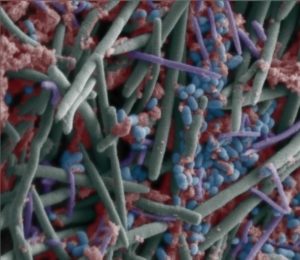
The community of microbes in the mouth is the oral microbiome. The oral microbiome is the second largest microbial ecosystem in the human body after the gut.

The researchers studied 192 individuals and found that not only is the diversity (variety) of oral microbes different in obese individuals, but also the composition of their microbes is different (when compared to healthy persons of normal weight). The oral microbiome is obese individuals was imbalanced (dysbiosis).

They found that overweight individuals also have higher numbers of microbes that produce lactate. High levels of lactate are associated with an increased risk of type 2 diabetes and poor metabolism. The researchers summarize why these microbial differences are important:

"Compounds generated by oral microbes can interact locally with oral tissues or enter circulation, triggering various signaling mechanisms in distant organs. Lifestyle factors, such as diet, smoking, oral hygiene, and antibiotic use, can shape oral microbiome composition. Emerging evidence links oral dysbiosis to several metabolic diseases, including obesity."

Bottom line: Try improving your diet, brushing your teeth, and not smoking to improve your oral microbiome.

From Medical Xpress: Microbes living in our mouths could hold the key to obesity prevention

Scientists may have found a new way to spot early signs of obesity, which could lead to novel prevention strategies. A study published in the journal Cell Reports has discovered that people living with obesity have a distinct set of microbes in their mouths compared to people at a healthy weight. ...continue reading "The Microbes In the Mouth and Obesity"

Breastfeeding
Credit: Wikimedia Commons/ Anton Nosik

It has long been known that breast milk contains hundreds of microbial species (the milk microbiome), which help seed the infant's gut microbiome. Over the weeks and months of breast feeding, the microbial species in the milk change. All this is normal and good.

A recent study of human breast milk examined the species in breast milk and found that that the species could be viewed as a microbial ecosystem - one that is important in helping seed the infant's gut. The milk contained species that are considered beneficial (e.g., Bifidobacterium), but also some that can be viewed as not beneficial (e.g., E.coli). The milk was from healthy mother-infant pairs, so it was clear that this variety was normal.

Researchers analyzed 507 breast milk and infant stool samples from 195 healthy mother-infant pairs at one, three, and six months postpartum. They found characteristic mixes of bacteria dominated by Bifidobacteria (especially B. longum, B. breve, and B. bifidum). More than half of the milk samples contained B. longum, and that same species was abundant in over 98% of the infants' gut microbiomes.

The paper mentioned that numerous times they found the exact same bacterial strain in both the mother and infant pairs - thus evidence that the mothers transmitted that bacteria to the babies in the breast milk (this is referred to as vertical transmission).

From Medical Xpress: Breast milk microbes help shape infants' gut microbiomes, study finds

Most conversations about breast milk tend to focus on topics like nutrients, antibodies and bonding time rather than bacteria. But it turns out that human milk carries its own tiny community of microbes, and those passengers may help shape a baby's developing gut microbiome—which in turn can impact nutrient absorption, metabolic regulation, immune system development, and more. ...continue reading "Breast Milk Transmits Important Bacteria to the Infant Gut Microbiome"

Very depressing news. The EPA plans to NOT take into account of the value of human life any more when making rules and setting policy regarding air pollutants (e.g., fine particulate matter and ozone). Meaning that the value of a human life is zero dollars. Instead, the only thing that will be considered is the cost to businesses of pollution regulations.

In other words, no more estimates of the dollar value of lives saved in the cost-benefit analyses for new pollution rules. People dying will just be a side-effect of business - eh, move on, nothing to see here.

This means that the cost to society (of human suffering and deaths) from pollutants just doesn't matter. Businesses obviously do not/will not want regulations that cost money.  Yes, this will mean dirtier air and the environment going forward. Very depressing...

Excerpts from NY Times: Trump’s E.P.A. Has Put a Value on Human Life: Zero Dollars

Government officials have long grappled with a question that seems like the purview of philosophers: What is the value of a human life?

Under both Democratic and Republican administrations, the answer has been in the millions of dollars. The higher the value, the more the government has required businesses to spend on their operations to prevent a single death.

But for the first time ever, at the Environmental Protection Agency the answer is effectively zero dollars. ...continue reading "The EPA Now Values Human Life At Zero Dollars"

Breastfeeding
Credit: Wikimedia Commons/ Anton Nosik

Breast milk is considered the best food for infants, but it can be contaminated with chemicals the mother is exposed to in daily life.

A group of scientists analyzed samples of breast milk from nursing mothers in Canada and South Africa for contaminants and found low levels of pesticides, parabens (endocrine disruptors in plastics), and bisphenols, including bisphenol A and S (endocrine disruptor) in many of the samples.

They published several research papers with their findings. They found contaminants, but at different levels, in the 594 breast milk samples of Canadians and South African women. Unfortunately, all breast milk samples showed some contamination - which can occur from personal care products, the packaging used in foods, in medications, household cleaning products, or even as a food additive.

For example, methyl paraben was detected in 96% of the Canadian human milk samples, followed by ethyl paraben (57%) and propyl paraben (37%). The pesticide propanil (an herbicide) was detected exclusively in South African breast milk samples, as was the antiretroviral drug Efavirenz used in HIV treatment.

BOTTOM LINE: The researchers stress that breast milk is the best food (the gold standard) for infants, but women should realize that chemicals they are exposed to do get into breastmilk. Therefore, try to avoid pesticides, read ingredient labels, and try to minimize exposure to harmful chemicals.

From Newsweek: Scientists Discover Pesticide Traces in Breast Milk

Researchers at McGill University have identified several unexpected chemical contaminants in human milk, finding traces of pesticides, antimicrobials and additives used in plastics and personal‑care products.

The team said the data, drawn from Canadian and South African samples, could help strengthen chemical safety regulations and improve protections for infants and parents. ...continue reading "Breast Milk Can Contain Traces of Pesticides and Other Chemicals"

Processed meat contains preservatives. Credit: Wikipedia

Once again, preservatives found in ultra-processed foods are linked to health harms. A large study of 105,260 French adults found that higher intakes of some common food additives or preservatives are linked to certain cancers.

There was an association of higher intake of seven preservatives with a higher risk of overall cancer, and also with breast and prostate cancer. On the other hand, there was no link between overall preservatives and cancer - just with the 7 preservatives.

The researchers looked at the overall cancer rate, as well as the most common 17 preservatives, and found certain associations:  potassium sorbate with overall cancer and breast cancer, potassium metabisulfite with overall cancer and breast cancer, sodium nitrite with prostate cancer, potassium nitrate with overall cancer and breast cancer, acetates with overall cancer and breast cancer, acetic acid with overall cancer, and sodium erythorbate with overall cancer and breast cancer.

Bottom line: Read ingredient lists on food labels. Avoid foods that contain ingredients with chemical sounding names that are not normally found in a home kitchen. Those ingredients are in ultra-processed foods. Additionally, "natural flavors" are laboratory concoctions (found in ultra-processed foods).

From The Guardian: Studies link some food preservatives to higher diabetes and cancer risk

Higher consumption of some food preservatives is associated with an increased risk of type 2 diabetes and cancer, two studies suggest.

The findings, published in the medical journals Nature Communications and the BMJ, may have important public health implications given the ubiquitous use of these additives globally, researchers said. ...continue reading "Some Food Preservatives Are Linked To Cancer"

Processed meat Credit: Wikipedia

Many studies are finding that eating ultra-processed foods (UPFs) can lead to all sorts of health problems. A recent large study conducted in France found that people eating higher amounts of food preservatives had a higher risk of type 2 diabetes. Overall, people consuming foods with higher amounts of preservatives had a 47% higher risk of developing type 2 diabetes (when compared to people eating low amounts of preservatives).

Over 100,000 French adults were followed for more than a decade. The researchers found that 58 preservatives were in the foods they ate. The researchers examined 17 preservatives in depth (the most common ones eaten) and found that 12 preservatives are linked to type 2 diabetes: potassium sorbate, potassium metabisulphite, sodium nitrite, acetic acid, sodium acetates, calcium propionate, sodium ascorbate, alpha-tocopherol, sodium erythorbate, citric acid, phosphoric acid, and rosemary extracts.

Bottom line: Read ingredient lists on food labels. Avoid foods that contain ingredients with chemical sounding names that are not normally found in a home kitchen. Those ingredients are in ultra-processed foods. Additionally, "natural flavors" are laboratory concoctions (found in ultra-processed foods).

From Science Daily: Common food preservatives linked to higher risk of type 2 diabetes

People who consume higher amounts of food preservatives may face a greater risk of developing type 2 diabetes, according to a large new study. Preservatives are commonly added to processed foods and beverages to extend shelf life. ...continue reading "Food Preservatives Linked to Higher Risk of Type 2 Diabetes"

There has been discussion over the years regarding mouthwash - what are the harms and benefits? Does using mouthwash regularly disrupt the oral (mouth) microbiome? Chlorhexidine mouthwash is generally considered the best for treating gingivitis and killing bacteria.

Researchers at the College of Dental Medicine, Univ. of Sharjah in the UAE, recently published a review of studies comparing garlic extract mouthwash vs chlorhexidine mouthwash. They found that garlic mouthwash can be as effective as chlorhexidine mouthwash.

Garlic (Allium sativum) has natural antimicrobial properties. The researchers found that among the studies there were some differences in effectiveness for both types of mouthwash depending on the concentration used and duration of application.

However, one negative they found is that garlic mouthwash can be more uncomfortable to use - it can cause a burning sensation and unpleasant taste.

Excerpts from Science Daily: Garlic mouthwash shows shockingly strong germ-fighting power

Garlic extract has been found to offer antimicrobial effects that are on par with commonly used antiseptics and disinfectants such as chlorhexidine, according to medical researchers at the University of Sharjah.

The study, published in the Journal of Herbal Medicine, reports that garlic-based mouthwash may produce more discomfort than chlorhexidine but appears to provide longer-lasting residual activity.

...continue reading "Garlic Extract Mouthwash Appears Promising"

The health benefits of regularly drinking coffee keep increasing. A recent study confirmed that consuming coffee on a regular basis reduces the incidence of liver disease and slows the progression of several liver diseases.

The study authors write that coffee contains a number of bioactive compounds (e.g., caffeine, polyphenols, diterpenes) which have "anti-inflammatory, antioxidant, antifibrotic, and anticancer properties".

In other words, enjoy your daily coffee. It's good for you!

Excerpts from Medscape: Regular Coffee Drinking Can Protect and Restore Liver Health

TOPLINE: Several bioactive compounds in coffee exert antioxidant, anti-inflammatory, antifibrotic, and metabolic effects that reduce the incidence and progression of liver diseases. ...continue reading "Coffee and Liver Health"